not a rom-com girly
exploring love in cinema

Hello darling,
It’s February — capitalism’s month for romance and love.
I saw French Lover (2025) with some friends the other day and it was… better than most rom-coms. Lol.
But you know I’ve never really been into this genre.
*Sighs* Could it be bitterness from a girl whose heart has been broken in the past?
But actually, if there’s one thing in this world that I am absolutely obsessed with, it’s lovers loving each other (in a healthy relationship).
Ask Becca how long it took for me to stop celebrating when I found out she and her partner finally said “I love you” to each other. It made me so happy.
Not from a belief that partnership is the ultimate destination for everyone,
but because I know who they are, what they’ve lived, and what they long for.
It’s beautiful to see two gentle lights align.
So I think the rom-com thing has more to do with my propensity for realism.
I think rom-coms are a fantastical form of escapism that doesn’t provide me with the relief it gifts others because my regulation happens through coherence.
Reassurance comes from psychological truth.
I can surrender to abstraction — symbolism, surrealist art, etc. — because they still express reality, just the internal states. But my mind can’t seem to sit when complexities are glazed over and all is collapsed into spectacle.
I also just don’t like things that misrepresent humanity.
I think a lot of messaging today already misrepresents people in love because it simplifies love in ways that help sell things.
It doesn’t exactly lie. It just rarely tells the whole story.
Basically, whatever makes things more legible inside attention economies that reward immediacy, performance, and emotional compression.
So I appreciate when films choose to stay closer to the truth: Love via the constraint of nervous systems, resources, timing, and emotional capacity.
A few films have lingered in my mind with regard to this… some in the pain, some in the peace.


Although Damien Chazelle’s Babylon (2022) is mainly a film about capitalism as a cultural engine through the lens of early Hollywood, there is also the story of meeting someone who is at a different emotional stage and capacity from you — and falling for them anyway.
Nellie and Manny’s relationship is built on recognition, care, and genuine affection, but undone by a fundamental mismatch between who they are able to be over time.
Neither of them is dishonest, even though it is an unhealthy and uneven love.
Manny loves Nellie in a steady, protective, forward-looking way. He believes in her before the industry does and tries his best to build conditions in which she can survive — emotionally and materially. His devotion is sincere, but it gradually costs him his sense of self because he cannot uphold boundaries with Nellie.
Nellie understands this. She sees Manny clearly, knows he sees her, knows he is trying to help her, and I believe she loves Manny because he is the one place in her life where she doesn’t have to perform or defend herself. He is her anchor.
Nellie’s inability to be with him is not rooted in rejection or disdain, but in self-knowledge paired with a lack of self-confidence, and ultimately, a refusal to exploit Manny’s love just to survive a little longer.
Her exit is capitulation — a moment where she chooses not to work past her limits. Not because she doesn’t know another path exists, but because she doesn’t believe she can survive the cost of taking it.
Sometimes a relationship fails not because love is insufficient, but because love cannot reconcile incompatible internal architectures. Real?
I’ve never been the fatalistic type so I do believe that people in this dynamic can grow. However, loving someone is not the condition that makes that transformation possible. It would require dismantling an entire survival system — a long, destabilising journey that is often incompatible with maintaining a romantic bond, which requires immediate stability.
I think this is where people tend to say, “right person, wrong time”.
But if it happens that there was enough integrity to not drag a partner through years of collapse first — where you don’t ruin each other just to stay close, even when the feelings remain — people can change, heal, regulate, and build capacities they didn’t have before.
Nervous systems don’t decide destiny. Trauma can be integrated.
Many people who once looked like Nellie go on to live stable, healthy lives with the right conditions: time, safety, resources, accountability, and (often) professional help.
Alignment can happen between you later because it wasn’t demanded earlier.
But don’t let me feed your delulu.
We live open, but we don’t live our lives waiting for alignment that may never come.


Wong Kar-wai’s Happy Together (1997) is a study of a relationship that survives not because it is good, but because it is familiar.
Lai and Ho are lovers who cannot live well together, but cannot stay apart.
Their love is real, but it is also toxic and unsustainable.
Their relationship is defined by a loop that stalls their development: break up, reconcile, collapse, repeat.
Each return isn’t driven by a hope that things will be different, but by a shared emotional language built out of chaos, intensity, and dependence.
Pain is familiar; loneliness feels worse.
Ho is volatile, impulsive, and emotionally demanding. He pulls Lai back whenever he feels abandoned, not with promises of change but with vulnerability and need.
Lai is more restrained, more self-aware, and quietly exhausted by the cycle — yet he continues to return. Partly out of love and partly because he has organised his sense of self around caring for Ho.
What’s uneven here is not love, but cost: Lai absorbs the emotional labour and long-term erosion, while Ho’s volatility is repeatedly accommodated rather than contained — protected by the ambiguity of being “difficult” rather than held accountable.
A further ache in this relationship is that clarity does not free them.
Lai knows they are bad for each other. Ho likely knows too, on some level.
But knowing doesn’t dismantle attachment.
Their bond is sustained because chaos feels like home, intensity feels like proof of aliveness, loneliness feels more existential than pain, and suffering together counts as connection.
The film never moralises this dynamic. It doesn’t frame Ho as a villain or Lai as a martyr. Instead, it treats their relationship as something shaped by emotional immaturity, loneliness, displacement, and the difficulty of building identity outside of another person.
Sometimes people can mistake intensity for intimacy because familiarity with pain can feel safer than the uncertainty of freedom.
For situations like this, awareness of healthy versus unhealthy love is there.
But until you experience it, it’s hard to believe in it. And until you believe in it, it’s hard to be in it. Chicken and the egg.
Of course, understanding why someone behaves harmfully doesn’t undo the harm they cause — and clarity doesn’t always arrive before damage is done.
The hope is that both these individuals will one day gain enough experience that retrains their nervous systems… To where they don’t have to suffer to feel real. Where intensity isn’t processed as intimacy. Where they can experience being truly seen — insecurities, mistakes, “flaws” and all — and still be loved. Where vulnerability feels like connection instead of exposure. Where they feel worthy of being held with care.
And maybe one day, the unfamiliar will feel more like possibility and they are able to rest inside the calm.
Though I know the difficulty here is that they will only receive those experiences if they can work past their fears to be consistent, respectful, and reciprocal.


The most realistic depiction of a healthy relationship I’ve seen thus far is probably in Jim Jarmusch’s Paterson (2016).
Paterson and Laura love each other quietly.
There is no grand narrative of “becoming,” no conflict that must be overcome to prove devotion. The film resists the idea that love must advance toward something in order to be meaningful. Instead, it suggests that love can simply be a structure that makes it possible to be present and create without burning out or collapsing inward.
There’s no performance.
Their bond is expressed through small rituals: shared breakfasts, listening without interruption, walking the dog, and noticing each other’s moods.
Paterson supports Laura’s shifting creative passions without judgement or condescension. Laura encourages Paterson’s poetry without demanding ambition, recognition, or productivity from it.
Neither tries to reshape the other into something more impressive or legible to the world. Neither uses the other to stabilise or validate a fragile sense of self.
Any differences they have are not treated as deficits.
They coexist with ease, showcasing love as a shared rhythm that allows both people to remain themselves.
I think this is where people tend to say “real, healthy love is boring”.
Their relationship isn’t exciting in the cinematic sense,
but it is emotionally secure, mutually respectful, and deeply humane.


Another Jim Jarmusch film. In Only Lovers Left Alive (2013), Adam and Eve’s relationship is not built on romance in the conventional sense, but on endurance and attunement.
They are elder lovers who have already passed through the phases most films obsess over — infatuation, rupture, reunion, proof.
What remains is something quieter and rarer: a bond sustained by deep mutual recognition and an ongoing choice to keep each other alive, literally and emotionally.
Adam is melancholic, withdrawn, and prone to despair.
Eve is curious, grounded, and quietly resilient.
The relationship works because they regulate each other.
Eve doesn’t try to fix Adam’s darkness or deny it; she simply stays present with it, offering steadiness, humour, and perspective. Adam, in turn, reveres Eve — not as a saviour or muse, but as an equal mind and companion who makes existence bearable.
Crucially, this relationship is also without performance.
There are no grand gestures, no power struggles, no tests of loyalty.
Their intimacy is slow, tactile, and respectful.
They don’t collapse into each other to escape the world; they stand side by side against it.
What makes their relationship feel “healthy” in contrast to other cinematic couples is that love here is possible because capacity already exists. (“Healthy” because we are talking about vampires here.)
Both Adam and Eve are emotionally literate, self-aware, and not trying to use love to fill a void or outrun pain. Their bond doesn’t demand transformation or sacrifice of self; it allows for difference, solitude, and even sadness without threatening the connection.
It’s a portrait of love grounded in the knowledge that staying is a daily, deliberate act.
This is actually one of my favourite films.
It’s just so calm and beautiful.
They see the decay, the stupidity, the violence, the repetition — and yet, they choose to stay. With the world. With one another. With oneself. Even when cynicism would be easier.
The exhaustion is softened by art, memory, and a love that has learned how to last.
I also believe that Adam and Eve are two poles of the same sensitive consciousness that we all carry within us.
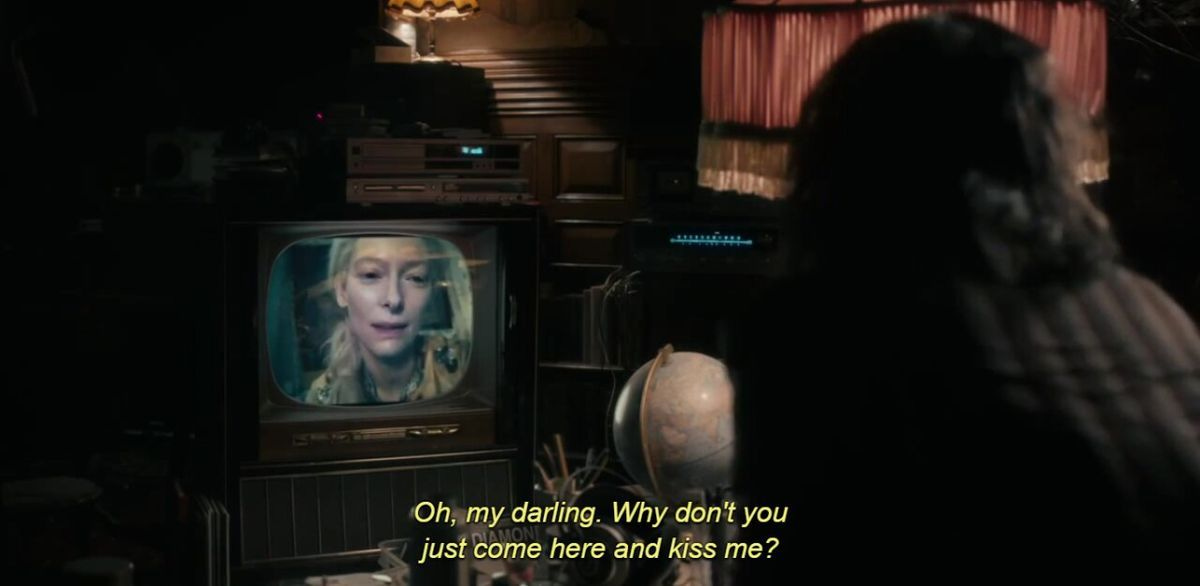
I appreciate these films because they aren’t just honest depictions of humans in love, but maps for recognising where we are and what we’re actually capable of holding.
Though going through this list, I’ve just realised…
I rarely see films where people of colour are shown simply loving each other in a healthy, long-term relationship without crisis.
Of course we exist in reality, but I’ve had trouble finding the representation in film.
If you know any, please send them my way.
*
Anyway, I know this time of year sometimes makes you feel a bit lonely.
You’re not alone in that. I get there too.
We’re human. We’re wired to yearn.
But if it ever gnaws at you a little too much, you can let me know.
I am just one call away. And I don’t mind making a trip either.
With love,
Your fellow lover girl,
Solène
---
Written from somewhere in the mountain states.


A few love songs 4 u:
“Shaking Things Up” - nimino this one always makes me smile
“Mine” - BAYNK, Cub Sport those beginnings
“Infatuated” - Memphis Bleek, Boxie corny, but it’s what I dance to while prepping dinner (millennilol)